The Twibbons of Historically Black Greek-letter Organizations
Founded to challenge the exclusivity of American campuses, these organizations widen their influence in the digital realm with Twibbons

In the first week of January 2026, three of nine historically Black fraternities and sororities in the United States published Twibbons for their founding anniversaries within four days of each other: Phi Beta Sigma, Delta Sigma Theta, and Alpha Kappa Alpha.
The clustering follows the calendar they inherited. Phi Beta Sigma was founded on January 9, 1914. Delta Sigma Theta on January 13, 1913. Alpha Kappa Alpha on January 15, 1908. All three were established at Howard University more than a century ago.
The nine are what the National Pan-Hellenic Council calls the Divine Nine. Alpha Phi Alpha came first, at Cornell in December 1906, the first intercollegiate fraternity among African American men. Alpha Kappa Alpha followed at Howard in 1908, the oldest Greek-letter organization founded by African American college women. Then Kappa Alpha Psi at Indiana and Omega Psi Phi at Howard in 1911, Delta Sigma Theta in 1913, Phi Beta Sigma in 1914, Zeta Phi Beta in 1920, Sigma Gamma Rho at Butler in 1922, and Iota Phi Theta at Morgan State in 1963. The council itself became permanent at Howard in 1930. Combined membership across all nine now runs past two million people.
They were founded as a response to segregation and exclusion of African American students on campuses. White fraternities did not admit Black students, and the institutions that did limit their resources for the Black cohorts.
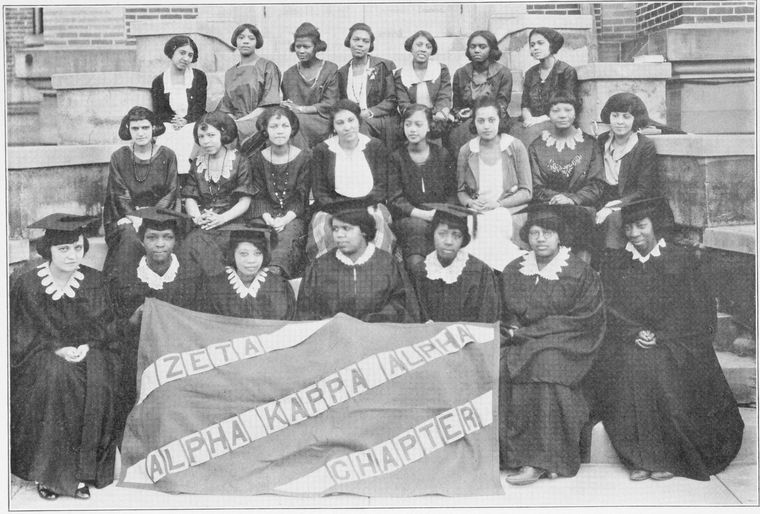
Alpha Kappa Alpha Zeta Chapter, Wilberforce University, 1922 Credit: NYPL
What the Divine Nine built in response was not a set of social clubs. The Smithsonian describes them as established on personal excellence, racial uplift, community service, civic action and kinship, and the record bears that out from the beginning.
Membership in any of the nine does not end at graduation. Members join a chapter, chapters sit inside regions, regions answer to a national body, and national bodies meet at conventions with their own names, a Boule for Alpha Kappa Alpha and Sigma Gamma Rho, a Conclave for Phi Beta Sigma. Alpha Kappa Alpha alone reports more than 1,122 chapters. That structure runs decades deep in most members' lives.
Five of the nine have campaigns on Twibbonize: Alpha Kappa Alpha, Delta Sigma Theta, Phi Beta Sigma, Zeta Phi Beta and Sigma Gamma Rho appear with their frames throughout the year.
The purposes are worth listing, too, because they describe the year these organizations actually keep. Founding anniversaries are the largest: Alpha Kappa Alpha's 116th has 42,223 supporters and its 117th has 15,301, Delta Sigma Theta's 113th has 32,730, Phi Beta Sigma's 108th has 6,061.
National conventions produce their own. The Official AKA 72nd Boule Frame went up on July 10, 2026, eight days before the convention opened, and it has 5,835 supporters. This is an attendee badge rather than a frame to mark a day. The convention brought more than 27,000 members to the Mandalay Bay in Las Vegas.
Regional conferences come next, including Delta Sigma Theta's 50th Southern Regional Conference this August with 2,024, and a joint 2026 Great Lakes frame shared by Zeta Phi Beta and Phi Beta Sigma, bound to each other constitutionally since 1920.
Other than these, the frames get more specific. The Southwestern Region of Phi Beta Sigma runs one called Frat Friday, for a weekday rather than an occasion, with 759 supporters. Delta Sigma Theta's Southern Region built one around a six-week fitness challenge ahead of a conference. There is a frame for Zeta Phi Beta life members, the women who have paid in permanently, marking a standing inside the organization rather than a date on its calendar. There is a breast cancer awareness frame for Zeta Phi Beta, and a graduate chapter retreat frame.
The creators are not only head offices. Regional marketing teams publish their own. Individual members publish theirs, and the largest Alpha Kappa Alpha frame this January came from a member rather than the sorority, drawing 11,641 supporters.
These campaigns fill up because of their strength in membership. Nobody outside these organizations searches for a Frat Friday frame. Everyone who joined one arrived because a chapter officer, a group chat or a line sister sent the link.
A design published into a hundred-year-old network of chapters and regions and life members meets an audience that was already assembled and already clear on what the letters mean. The limits show in the same numbers. The Boule frame, for example, garnered 5,835 supporters, against a convention of more than 27,000 people in attendance, a fair reminder that a frame reaches only part of the membership, not the whole.
How these African American Greek-letter organizations were formed, and the size of the networks they built, may be part of why members stay dedicated long after graduation. And Twibbons amplify their membership online, from anywhere in the world. Using the Twibbon as a profile picture or a social media post becomes a statement anyone can see, rather than on a physical badge in front of a limited audience.
Twibbonize supplies a page, a design slot and a count of who joined. The organizations supply everything else. It is only the right thing to do that we put a spotlight on these campaigns rooted from a rich and inspiring history.